

What Is Cel Animation? (and When a Cel-Inspired Look Works for Explainers)
Every classic cartoon you grew up with was built, frame by frame, on sheets of clear plastic. That technique is cel animation — the workhorse of twentieth-century 2D, and the reason hand-drawn characters still feel so human on screen.
This guide covers what cel animation is, how the classic process worked, what replaced the plastic, and — most useful if you are choosing a style for a brand video — when a cel-inspired look still earns its keep in explainer videos.
What is cel animation?
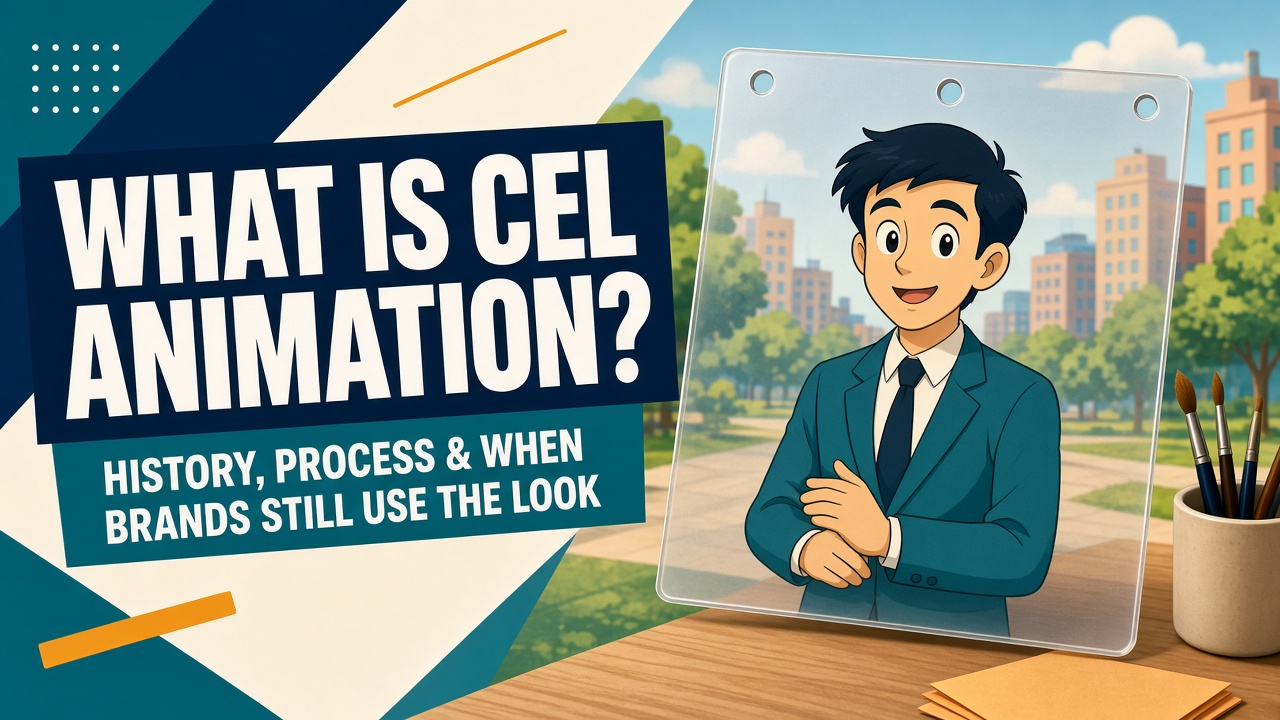
Cel animation is a traditional 2D technique where characters and moving objects are inked and painted on transparent sheets called cels (from celluloid), layered over a separately painted background, and photographed one frame at a time. Playback is typically 12 or 24 frames per second, which is enough for the eye to read fluid motion.
The transparency was the breakthrough. Artists could redraw only what moved and leave the background alone. That labour-saving idea, patented in 1914 by Earl Hurd (working with John Bray), is why cel animation scaled from short cartoons into features and decades of television.
Today, almost nobody stacks acetate under a film camera for a commercial project. The look and the logic — layered, hand-drawn 2D — are alive and well in digital ink-and-paint pipelines, including many of the 2D animation styles brands use for explainers.
How cel animation works
A full studio pipeline was a small factory. Here is the classic path, without the hobbyist brush tutorial.
From storyboard to pencil tests
It starts the same way modern explainers do: script, storyboard, timing. Layout artists lock camera and composition. Key animators draw the important poses on paper over a lightbox and peg bar. Assistants fill the in-betweens. A dope sheet (exposure sheet) tells the camera crew how long each drawing holds — often “on twos,” meaning one drawing for two frames of film.
Ink and paint on acetate
Approved pencil drawings were transferred to cels. Early on that meant hand inking; later, xerography copied pencil lines straight onto plastic (Disney leaned on this heavily from One Hundred and One Dalmatians onward). Colourists painted on the reverse of the cel with opaque gouache or acrylic “cel paint,” so the inked line stayed crisp on the front.
Layering, registration, and the animation camera
Finished cels sat on registration pegs over a painted background. Multiple cels could stack when several characters moved. A glass platen held everything flat under a rostrum (animation) camera. Shoot, swap the next drawing, shoot again — thousands of times per minute of finished film.
Special setups like the multiplane camera put artwork on separated glass levels so foreground and background could parallax, adding depth without 3D models. Ub Iwerks and Disney’s vertical multiplane made that idea famous in the Snow White era.
Key terms worth knowing
| Term | Meaning |
| Cel | Transparent sheet carrying character or object art |
| Acetate / celluloid | The plastics used for cels (nitrate → acetate → polyester) |
| Ink & paint | Line transfer plus reverse-side colour |
| Multiplane | Layered glass planes for parallax depth |
| Limited animation | Fewer unique drawings; hold bodies, animate mouths and eyes |
| Xerography | Photocopying pencil art onto cels |
| Digital ink & paint | Same layered logic in software — no plastic |
| CAPS | Disney/Pixar’s Computer Animation Production System |
If you only remember one distinction: cel animation is a production method. Cel shading (toon shading) is a 3D rendering style that mimics flat colour and outlines. A game can be cel-shaded and never touch a cel.
A short history: Disney, UPA, and Japan
Bray, Hurd, and Disney’s industrial peak
After Hurd and Bray’s 1914 process, Disney industrialised full animation: huge crews, painted backgrounds, and multiplane spectacles. Snow White and the Seven Dwarfs (1937) proved a feature-length cel film could work commercially and culturally.
UPA and limited animation
Not every studio chased Disney realism. UPA in the 1940s–50s pushed graphic, stylised design and limited animation — fewer drawings as an aesthetic choice as much as a budget one. That idea shaped TV cartoons (Hanna-Barbera and peers) and, later, the economics of a lot of television anime.
Anime’s TV economy and theatrical craft
Japanese TV animation leaned hard on limited animation to ship weekly episodes. Theatrical houses such as Studio Ghibli kept the hand-drawn lineage at a much higher craft level. Different budgets, same family tree: drawings, layers, timing.
CAPS and the end of physical cels
Materials evolved too: flammable nitrate gave way to acetate (which brought “vinegar syndrome”), then more stable polyester. Paint still cracked and lifted on ageing cels — which is why vintage production art needs careful storage.
Digitally, Disney’s CAPS system replaced ink-and-paint departments. The Little Mermaid (1989) still leaned on traditional cels with early digital experiments; The Rescuers Down Under (1990) is widely cited as the first Disney feature finished entirely with CAPS. By the 1990s, major Western studios had largely abandoned physical cels. Some Japanese TV holdouts lasted longer; Sazae-san is often cited as switching fully digital in 2013.
Physical cels became collectables. The production method moved into software.
Cel animation vs digital (and vs cel shading)
| Traditional cel | Digital ink & paint (2D) | Cel-shaded 3D | |
| What it is | Drawings on plastic, shot on film | Frame-by-frame or hybrid 2D in software | 3D models with flat/toon shaders |
| Labour | Huge crews, physical materials | Artists + digital pipeline | Model, rig, light, render |
| Look | Hand-drawn, slight texture and line life | Can match or refine the cel look | Graphic, often “anime-like,” but 3D under the hood |
| Best for | History, art, boutique projects | Brand explainers, series, ads | Stylised product/game worlds |
Cel vs digital: the artistic principles are shared — timing, arcs, appeal, the 12 principles of animation. Digital swaps acetate, paint pots, and a film camera for tablets, TVPaint/Toon Boom/Animate-class tools, and compositing. You still care about keys, in-betweens, and clean shapes.
Cel vs cel shading: if someone asks for “cel animation” and means a flat-shaded 3D product turntable, clarify early. Different craft, different quote, different pipeline.
For a wider map of options, see our round-up of animation styles and types of animation.
Why the cel look still matters in marketing
Nobody is asking your SaaS launch video to be shot on nitrate. They are asking it to feel crafted.
A cel-inspired, frame-by-frame 2D look signals care. Characters read as designed, not templated. That helps when you need empathy (healthcare), trust (fintech, security), or clarity without sterile UI chrome (complex B2B products). Anime-influenced brand films and premium commercials keep proving the point: audiences still lean in for handmade motion.
Nostalgia is a bonus, not the whole strategy. The real advantage is differentiation from the same motion-graphics kit everyone else rented last quarter.
Should your explainer use a cel-inspired style?
When yes
- Founder or heritage stories where craft is part of the brand
- Character-led explainers that need warmth and emotional retention
- Topics that benefit from metaphor and journey, not only UI callouts
- Campaigns where standing apart from stock puppet or lower-thirds templates matters
When another style is smarter
- Rapid iteration and heavy A/B testing (leaner cut-out or puppet rigs often win)
- Dense product tours that are mostly interface
- Data-heavy stories that want pure motion graphics
- Ultra-tight timelines where full custom frame-by-frame is the wrong spend
How Animation Explainers approaches “traditional 2D” today
We do not float-paint acetate for typical brand packages — and you would not want the cost or fragility. We keep the intent of cel animation: custom characters, deliberate timing, layered 2D that feels drawn, not dragged from a template.
Our usual path matches what clients already know from our animation process: script → storyboard → custom animation → voice-over and music → revisions. If you want more of a marker-on-board feel, our hand-drawn explainer work sits in the same family with a different on-screen personality.
Not sure which lane fits? A short brief is enough for us to recommend cel-inspired 2D, whiteboard, cut-out, or motion graphics before anyone draws a frame. Browse the portfolio or get in touch for a style steer.
FAQ
What is cel animation?
Cel animation is traditional 2D animation on transparent sheets called cels. Characters are inked and painted on those sheets, laid over a separate background, and photographed frame by frame to create movement.
How does cel animation work?
Teams board and time the film, animate on paper, transfer approved drawings to cels (by hand or xerography), paint colour on the reverse, stack registered cels over a background, and shoot each frame with an animation camera.
Is cel animation still used?
Physical cels are rare outside art, restoration, and boutique projects. The method survives as digital ink-and-paint and frame-by-frame 2D — widely used in anime, advertising, and brand explainers.
What is the difference between cel animation and digital animation?
Cel animation uses plastic sheets, paint, and a camera. Digital 2D keeps the same layered, hand-drawn logic but draws, colours, and composites in software. Principles overlap; materials and speed differ.
Cel animation vs cel shading — are they the same?
No. Cel animation is a 2D production method. Cel shading is a 3D rendering style that imitates flat colours and outlines. They can look related; they are not the same craft.
Why were backgrounds more detailed than characters?
Backgrounds were painted once. Characters were redrawn for every frame. Studios put lavish detail where it would not multiply labour thousands of times.
What is limited animation?
Limited animation uses fewer unique drawings — holding bodies still while animating mouths, eyes, or a single limb. UPA treated it as design; TV and much anime used it for schedule and budget.
When should a brand use a cel-inspired explainer?
Choose it when character, craft, and emotional clarity matter more than rapid puppet-style iteration. Skip it when you need weekly UI updates, heavy data motion, or the cheapest reusable rig. —
The short version
Cel animation built the golden age of cartoons by putting moving art on clear plastic and photographing it one frame at a time. The plastic mostly retired; the idea did not. Digital pipelines still chase that handmade 2D feel — and for the right brand story, a cel-inspired explainer still outperforms a generic template.
If you want help deciding whether that look fits your next video, Animation Explainers is happy to recommend a style from a short brief — no acetate required.